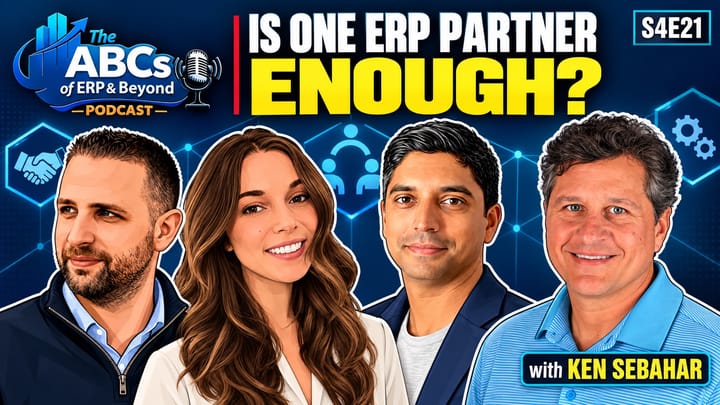
S4E21 | Should You Have More Than One ERP Partner? — with Ken Sebahar
There's one piece of ERP work you keep putting off. You trust your partner, you like them, they answer the phone. But this particular job needs experience they don't have. This week Pete, Nirav and Emily are joined by Ken Sebahar, who has been implementing Navision since 2001…
S04E21 · 53 min
Episode notes
Send us a message about this episode!
There's one piece of ERP work you keep putting off. You trust your partner, you like them, they answer the phone. But this particular job needs experience they don't have. This week Pete, Nirav and Emily are joined by Ken Sebahar, who has been implementing Navision since 2001, used to co-host A Shot of Business Central and a Beer, and has just written a white paper, The Multi-Partner Advantage. The question is whether you can bring in a specialist without blowing up the relationship that already works.
In this episode:
- "Who asked you to change partners?" Adding a specialist doesn't mean leaving your partner
- What a partner strategy is, and why you need one even with a single partner
- The EDI test: is it the best solution, or the one your partner knows?
- How to tell your current partner without making them feel fired
- Who you call when it breaks: primary support partner, partner team, clear lines
- AppSource, curated app lists and owning your own system
- When one partner is plenty
Hosts: Peter Nicholson · Nirav Shah (AdCirrus ERP) · Emily Browning
Guest: Ken Sebahar, independent Business Central consultant and advisor, Speaking Business Central (speakingbusinesscentral.com)
No sponsors, no adverts.
Transcript
The speaker labels and timings come from the edited Riverside transcript.
Read the full transcript
Peter Nicholson (00:24)
There's one piece of ERP work that you keep putting off. you trust your ERP partner, but this particular job just needs experience they don't have. Well, Ken Sebahar's paper asks whether bringing in a specialist could help you get it done while keeping the relationship that already works. And as ever, welcome back to the ABCs of ERP and Beyond. My name is Peter Nicholson and I'm joined with Nirav Shah and Emily Browning, but for today.
We have a guest. We have joining us Ken. Ken is from Speaking Business Central. And he began implementing the Vision way back in 2001. And he actually previously co-hosted a shot of Business Central and a Beer. So for me, it's a little bit weird because I listened to every single episode. So I'm kind of feel like I'm starstrucked with with Ken on board today. So I'm actually sitting here
Ken Sebahar (01:14)
I love it.
Peter Nicholson (01:16)
and I have, I have already prepped. I do have a beer, and I don't have a
Ken Sebahar (01:19)
Yes.
Peter Nicholson (01:20)
A usual
beer. I have actually got an an odd one. It's a very local beer from the Lake District in the north of north of England. tiny brewery, so it's it's a nice pale bitter. So that's what I'll be drinking. I am in the UK, yes, just so people know. It's three thirty nine PM, so it's socially acceptable. So there you go.
Ken Sebahar (01:42)
Yeah, it's after twelve PM, so after noon. So
you're good.
Peter Nicholson (01:46)
so I
thought in in recognition of that podcast I got so much value out of a few years ago. I thought I'd crack a cold one open today. but we have a lot to get through today, so we're gonna get straight into it. Ken, welcome. Welcome to the team. This is the ABCs of ERP and Beyond. we talk about everything about ERP, but we also try to come at it from a
different angle and I think today's topic is perfect for that. We try to talk around implementation of ERP, what ERP is all about, but give people advice from both the partner side. So Nirav Shah comes from AdCirrus ERP and his extensive background on ERP vendor side of of ERP joins us. we also have me and Emily. We come from the business. We come from the
actual end user, we implement it. We actually work day to day with end users actually on the on the customer side as well. So I think that's that's really what we're trying to do. We're trying to spread the ERP message. and well we thought who better to have on with this topic is yourself. So tell us a little thirty second pitch of of Ken.
Ken Sebahar (02:50)
Yeah. Sure. Thanks. Thank you all, Emily, Peter, Nirav for for having me on. appreciate it. And sitting on the other side here as as a guest is is just about as fun as as hosting the podcast was. but yeah, no, I appreciate you having me on. Yeah, I I you know I started out way back when with an accounting degree. I started as an accounting manager as an end user. I just happened to be at a company that developed software. so I kind of got exposure.
to to to a lot of the technology side and then really quickly moved into technology like ERP consulting and and support and and so on. So yeah, and I spent most of my career working my way up the ladder at a Microsoft partner in the Chicago area in the US, you know, from application consultant up to CEO over about only took me 23 years to to do it.
And and now I'm just doing consulting. I'm back. I have my kind of consultant hat on and advisor hat on. and I'm just helping companies basically just optimize their use of business central and and the whole surrounding kind of ecosystem. so yeah, thank you again for having me on.
Peter Nicholson (04:00)
Yeah, it's great to have you. so today's topic is really focusing in on your white paper, right? I I read it earlier this morning, and I found myself nodding along with a lot of the points that you make in that. And really we want to really explore this whole idea of of where and when several partners make more sense. Right. So well obviously linked to your white paper and I was really interested to see that backstory of you know the old way of ERP when it was on on prem, especially with
Navision it's proprietary database, it was all locked. It was very kind of the only thing you could do was even from the licensing point of view, right? Is have that single vendor. But in today's world where everything is more and more it's online, we're now away from on-prem, most of us are trying to move, migrate to the cloud, where everything suddenly wants to be connected to everything else, right? which
has its difficulties and complexities, but it does open the door to what your white paper explores is this whole idea of, well, you know, don't just think that you have to ha continuously work with your one ERP partner, especially when you have a gap in your business process or a gap in your ERP, right? And there's this third party solution that would be perfect. And maybe you feel that you can't really leverage that because your ERP partner
isn't skilled in it or doesn't know how to integrate it. So I'm really keen to get into some of your topics. But in general, w I wanna start with what kind of what kind of made you write this in the first place? What were you seeing out there?
Ken Sebahar (05:31)
Yeah.
Yeah. Great question. Yeah. So really what what what what spurred it was I'm out there, I'm talking to businesses, they're running business central, there's a clear gap or issue or some pain, right? And you know, I f I feel like I could help or or other people that I know could help. And almost
always the first instinctive reply is well we're we're happy with our partner or we're not we're not interested in changing partners right now and in my head i'm thinking who asked you to change partners right
Nirav Shah (06:11)
Mm-hmm.
Ken Sebahar (06:12)
and and i got to the realization that i believe that a lot of people just
are under this assumption, due to whatever reason, that they have to have a business central partner. Right. And that partner it needs to be the organization that provides all of the support, all of the consulting, anything that has anything to do with business central, tangentially or or directly, like that, that that has to go through that partner. And that, if
They decide to bring in someone else, maybe a s a smaller partner, an independent consultant, whatever, that that there's gonna be friction and hurt feelings and people are gonna be upset and threatened and scared or whatever the whatever term it is, right? and it just got to be like, you know, it does it doesn't have to be that way. It shouldn't be that way. Right. So, so where I got to where I got back to is like.
Why, you know, thinking why are people afraid? Why are they not willing to to utilize multiple partners? And I so I started going down that rabbit hole, right? And then I got back to the first point was, well, it's they really don't have a partner strategy, right? They just have a a Microsoft partner.
Business Central partner that they work with. And by the way, this could apply across other ERP solutions as well, you know, besides besides just business central. But, you know, and it's because they really haven't ever thought about it. I don't think it's just this. I have to have a partner. Hopefully, my partner can do everything I need them to do. Let's find a partner that can do everything we need. And what I it my point is just that you you're it's getting more and more difficult to find one partner that's an expert.
In everything that an organization might need them to be an expert in. And so I think it because of that challenge, you just have to get into this mindset of let me define my partner strategy. I I think of it this way: how can I best utilize the Microsoft Partner Network? Right. and that could take various shapes and forms. It could be just one partner, but
It could not be. So I think that it's just making this this realization that that that you should be thinking about a partner strategy and what makes the most sense for your organization.
Peter Nicholson (08:22)
All right, let's start with that point then when we talk about partner strategy because I did notice that reading your stuff you talk about regardless of whether you have a single partner or a multi partner setup, either way you should start with a strategy. so I I think every company out there
are either one or the other, right? There's no kind of third option there. And and you spoke about many, many businesses out there are on a single partner strategy, but None of it's really documented and there's no evidence there. So regardless of whether I'm choosing between single or multi, what should I have in place anyway? So what does the strategy look like?
What do I need to actually have in place?
Ken Sebahar (09:01)
Yeah.
Yeah. So it it really it doesn't have to be anything that's terribly complex. you know, I've kind of put together kind of a template, you know, that I have, but it it it really just in it it starts with this at the highest level is what are my expectations from my partner? Right? And and documenting that and then sharing that with your partner or partners.
to say this is what I'm looking for. And you know, there's there's there's a lot of levels of detail there, but ultimately you're saying, look, these are the strengths that we have internally here.
I have a strong financial team. We we really understand what we're doing from a financial reporting and a chart of accounts and dimension setup, but we're really struggling with this area. And so beyond, let's say manufacturing. So beyond you know, just implementing manufacturing, we're gonna look to you for for guidance and help on on helping us set up.
How should we set up our routings? Right. So, so just that framework. What level of support are you going to require? and and these are things that just sometimes they just go unsaid. And it what it ends up with is a lot of miscommunication, right? and and poor results between that relationship. So a simple example is, you know, customer goes live and they're live for like three or four months and then they're
They're looking at their balance sheet and their inventory accounts and none of them are reconciled. And and they call up their partner and say, What's going on with this system? You know, the partner comes in and goes, Well, you you haven't done your month end steps of closing your inventory periods and updating your posting dates. And they go, Well, that's your so you should be doing that for me, right? As I thought that's what you guys were doing.
Like we're on the support contract. Aren't you guys helping us maintain the system? Right? It's just kind of a simple example. but but there's there's a ton of you know variants of that. So it's really just listing what are the areas that we need that we are going to rely on you for as a partner. Obviously, business central comes into play there, but it could also be Power BI. It
Nirav Shah (11:07)
Yeah. Mm-hmm.
Ken Sebahar (11:08)
could also be help.
support an integration with an e-commerce solution maybe that they're running. So like what is the list of the areas where so where support is going to be needed or that the partner is going to be needed. what are the response times and a lot of times support support agreements might have this in place but you know just defining how we want to work with our partner what we expect our partner to provide for us because if you've been around you know that there's from you know a small
company that might have 10 users is significantly different than a larger enterprise size company with two or three hundred users and and how they rely on their partner on a day-to-day basis. So so it's at its core, that's really what it is. And then I think as you go through that process of defining that that strategy, you identify those some of those gaps
Peter Nicholson (11:57)
Mm-hmm.
Ken Sebahar (11:58)
where you may see that we need to bring in someone else.
Peter Nicholson (12:00)
All right, I wanna bring Emily on this because I've worked firsthand with her and she's awesome at digging through a vendor, assessing them, whether they're the right fit for the company itself, both on a cultural level and a technical level as well. also some experience on third party solutions, right? We could have our ERP partner that does everything about ERP, but then we could have a, you know,
third party that's doing EDI, for example, or WMS or something like that. So Emily, when we're talking about this kind of strategy on what the company needs from their vendor, we need to have both the business in our mind, the support in our mind, but also the end users and the day-to-day support that they might need. So when we're looking at building out our strategy and our working relationship, I guess, with with vendors, what are you looking for from them?
Emily Browning (12:51)
Thank you, Pete. I I mean what I'm looking for, I I think really is in line with what you've outlined within the multi-partner strategy because I'm I want people who have really good, deep expertise in, you know, the the the main things that we do. and definitely that impacts who we choose. and it definitely gets harder to do
the larger or more diverse the company is that you work for because now there are more things we need to take we need to account. so the question that's kind of going through my mind as you're talking about this, you know, what what do we need set up to set up first? And what's, you know, what's that list of things that we need? If I'm kind of going into it thinking, well, we can have multiple partners here, does that mean that I, you know, if I have my list,
Partners then don't need to tick every box, right? I can be thinking, let's find one that's really great at say, you know, the backbone of what we're doing, finance, manufacturing, but maybe another part of it is around, the customer relationship and there's, you know, there's something different we can do there. How how would you approach it in that sort of larger, more diverse company?
Ken Sebahar (13:56)
Yeah, yeah. I I would say that in in that scenario, those boxes that you're ticking off when you're evaluating a vendor, right? Your partner you're gonna work with, it's probably getting harder and harder to check off all those boxes.
Emily Browning (14:11)
Mm-hmm.
Ken Sebahar (14:11)
Right. and especially if your goal, like you said, you mentioned, is to provide deep knowledge, deep functional knowledge and expertise in that area, right? You want to look at what's my best option for meeting this need, whatever it is. Let's stick with EDI as an example, right?
I would say
in a common example, you let's say you're working with a Microsoft partner and and you say, Hey, we need to implement EDI, and and you know, that partner, they may recommend one solution to you. Why? Well, because that's the solution that they are expert in, right?
Emily Browning (14:48)
Mm-hmm.
Ken Sebahar (14:48)
Is is that the best solution or not? they also may just have an EDI person or or team on staff, but that they're not really experts. They've done it before, right? I and and you as a as a user, do you want to take that risk, right? Like, well, you I I I'm not.
hearing a ton of confidence. You're just seeing some gaps in their answers and how they're answering questions. So at that point you you sense it, right? It's a you probably can sense that, hmm, I don't know. I'm I I feel like maybe this isn't the best option for us here. what a lot of people do is they just march forward. They go, Well, this is our partner.
This is what they're saying we should do. And these, this is, these are the people that should do it. So let's just let's just go with that. but what I'm saying is don't do that, right? Go ahead
Emily Browning (15:37)
Mm-hmm.
Ken Sebahar (15:38)
and look at other options. What what what are all what is the universe of options that are available to you? And you want to go into that project with the with as high a level of confidence that it's gonna get done well, right?
Emily Browning (15:50)
Mm-hmm.
Ken Sebahar (15:51)
'Cause there's just too much risk, especially in a larger project, right, that that it can go south.
Emily Browning (15:56)
Yeah. I mean I really like the idea of it because there could be a train of thought where you're thinking, okay, well, we've got, you know, we've got quite a lot going on here. so do we just go for, you know, one of the big companies? They've got lots of people. It probably used to be a bunch of separate companies that have now merged into one. They've they've got everything, but there's, you know, there's there's definitely an element of that that not being appealing. there's a, you know, there's a lot of benefits to working with smaller companies. So I think this this whole idea.
kind of yeah, covers a gap that that is there that is kind of hard to bridge. I'm kind of curious about
how this is managed behind the scenes anyway. Because to a to a point, if I have a good partner, if I need something that they have a gap in knowledge on, I'd kind of expect them to facilitate
something for me anyway. And maybe they do bring in another company or another specialist or something. So what what's the difference between that situation and kind of me as a company specifically having this multi-partner strategy?
Ken Sebahar (16:53)
Yeah.
so a lot of it just centers around like expectations and being open and having an open and direct relationship with your partner.
Emily Browning (17:02)
Mm-hmm.
Ken Sebahar (17:03)
there's just this natural inclination I've that I have just seen where if you said, hey, we're we're looking at we need to improve some element of let's say CRM, right? That that and it's gotta integrate with business central. So hey, you're a Microsoft partner, you know.
The partner is going of in just intuitively, inherently gonna want to take that business on, right?
Emily Browning (17:24)
Mm.
Ken Sebahar (17:25)
They're gonna wanna be able to solve the problems for you and do whatever they can. And to your point, who is doing that work? Are they bringing in someone externally? and that could work, right? That that definitely could work. but it's just there are other options, right?
Emily Browning (17:40)
Mm-hmm.
Ken Sebahar (17:41)
and and what I think the the key point is that you should be able to go say, hey, we're implementing this a little bit of CRM. I want you to know we we're gonna see if if you're interested in doing this and and building a proposal for us to get this done. But I am gonna talk to some other partners as well.
Emily Browning (17:57)
Mm-hmm.
Ken Sebahar (17:58)
And the key there is
The what what happens right? As soon as I said that, if I said to you, hey Nirav, Nirav, if I said to you, let's bring you into this, if I said, Hey Nirav, you've been doing a great job supporting me on Business Central,
Nirav Shah (18:09)
Mm-hmm.
Ken Sebahar (18:10)
but guess what? I'm gonna talk to a couple other partners too about getting this done. what's your first reaction? Probably, what did I do wrong? What's not going well? Why is Ken not happy with me? Right? But but that
Nirav Shah (18:21)
Yep. Yep. Yep. Yep. Yep. Yeah. That that is definitely
the first reaction.
Ken Sebahar (18:25)
Yeah, it's just human nature,
Emily Browning (18:27)
Mm-hmm.
Ken Sebahar (18:27)
I think, right?
Nirav Shah (18:28)
Yeah.
Ken Sebahar (18:29)
Like, I'm gonna go talk to some I wanna, you know, date some other people, whatever, right?
Nirav Shah (18:33)
Yeah.
Ken Sebahar (18:35)
Like
Peter Nicholson (18:34)
Mm-hmm.
Ken Sebahar (18:35)
it doesn't mean in this case that that that your partner has done anything
Nirav Shah (18:38)
Yeah.
Ken Sebahar (18:40)
wrong, right? You you and and and sometimes it's just poor, it's miscommunication, it's just a not the right tone and message to them to say, I would say, hey Nirav, listen.
I love our relationship. You've been doing a great job helping me operate Business Central. I love it. I just, we have this CRM project. It's very important for us. It has to go well. I
Nirav Shah (19:01)
Yeah. Yeah.
Ken Sebahar (19:02)
think I'm gonna need you to be a little a part of that. I don't know to what degree, but I am gonna talk to some experts in CRM or in that area, right?
that to to bring them in and help me. And I'm gonna need you to kind of work with us and we're all gonna be on the same page and we'll be all part of this team that's gonna try to get this done. so the first thing that has to be there is Emily as a as a business leader, your expectations and that that your partner may not have all those answers for you and that you can go to other places. And then your partner has to
accept that that that just because you want to bring in, you know, Peter for reporting and data analytics or whatever we're, you know, whatever we need to whoever's the guru here, right? That that that doesn't mean that there's a problem, that there's an issue.
Emily Browning (19:50)
Yeah, I think this is really good advice. Definitely the messaging of it to a point could make or break, because a an element of me thinks if I if I make a vendor think that I'm, you know, potentially leaving one foot out the door, then okay, to to a point you you probably won't reduce the level of service we get, but also I could understand why a a partner might start prioritizing
you know, other customers on their books. Okay, because I think we're especially when you're working with little companies, there's a lot of not quite handshake agreements, but you know, we've not been able to sign a document yet, but we're definitely going to need you in November. So please keep that time, you know, aside for us and give me some time to get it over the line on my end. That's the type of thing you want that that kind of trust. And I think that's something that you often get with smaller companies versus the big ones.
and you don't want to scare them off in that in that kind of situation. So yeah, that is good advice on how how to frame those conversations. And certainly that was one of my big question marks. it's written down on my notes, you know, how how do I break the news to our current partner? that we that we want to look elsewhere.
Ken Sebahar (20:55)
Right, right. And you know, and so sometimes sometimes they're the that relationship is broken, right? Or or they're right, you do have to change your primary partner, let's call it, right, to someone else. But but it does not have to be that at all, right? And may
Nirav Shah (21:11)
Yeah.
Ken Sebahar (21:12)
or maybe long term that is it, but but it's what a lot of what a lot of companies think is well I have to go through this whole giant evaluation to change partners.
Well, you don't. You right? Like, so and part of my whole the white paper explains that like you could be working with your partner, whether you're happy or not. And they're they're providing services for you, they're providing value, but at the same time, I can bring in another partner to help, to supplement support or provide some user training or some some power BI help or whatever it is, right? And
that that could be like a long-term transition, right? Or or or in in kind of fitting, think of like pieces of a puzzle, like where do I have the best resources? Well these guys, and a lot of times I know you talk about like big organizations and things, but like I found that even when I'm working as a partner with Microsoft, how many employees does Microsoft have? Like, I don't know, hundreds thousand hundred, a couple hundred thousand?
Nirav Shah (22:08)
Hundred thousand
Peter Nicholson (22:09)
Thousands.
Yeah, yeah. Yeah.
Nirav Shah (22:10)
yeah, yeah, hundred thousands, yeah,
absolutely.
Ken Sebahar (22:12)
I have found in multiple instances that there's really one person at Microsoft that can answer a question that I have. No shit, sorry. That
Nirav Shah (22:24)
Yeah, no.
Emily Browning (22:25)
Yeah.
Nirav Shah (22:26)
Absolutely right. Yeah.
Ken Sebahar (22:26)
Right? It's it's it's
astounding. But when you
Emily Browning (22:28)
Ha ha.
Ken Sebahar (22:29)
peel the layers of that question that you have and that issue that you're having, well, you have to talk to this person.
Nirav Shah (22:35)
Mm-hmm.
Ken Sebahar (22:35)
Amazing, right? that happens what whether you're a partner of a thousand resources or a partner of 25 resources. there's probably a person or two people that you're really need to get to.
And in in today's environment, you have a lot of these one to ten person partners that have tons of deep knowledge and expertise and experience. that it's almost like why like of course you should use that person. they're the best, right? That
Nirav Shah (23:03)
Yeah.
Ken Sebahar (23:03)
you've seen.
Peter Nicholson (23:04)
When you likened it to pieces of a jigsaw puzzle, I'm thinking if there's anyone out there listening to this and like, you know what? Yes, I have only got one ERP vendor and they're terrible on Warehouse, on WMS.
Nirav Shah (23:15)
Yeah.
Peter Nicholson (23:16)
I know that they're really strong on finance, you know, which is great for us. And they, you know, I really like them. They're nice people and they always answer the phone to my stupid questions. but we really want a barcoded warehouse and we need a WMS. And I feel that they're just stumbling through it, and I'm a bit worried. So now I'm looking for a specialist in WMS, or at least someone that's expert that can do it.
My problem is if I'm the customer, I could be thinking, My problem is now I didn't have a jigsaw puzzle to manage. I had one piece, which was the whole picture. Now I
Nirav Shah (23:46)
Mm-hmm.
Peter Nicholson (23:47)
have a jigsaw puzzle where each piece is a different partner that I've now got to manage. So how do you handle that as a as a company? You know, say for example, you know, you're sitting there and
something's wrong with the system, right? An end user has said there's something wrong with the system. an update has been pushed through on a Friday afternoon. pick lists have been generated in the system, but now they're not being seen in the warehouse.
How do I manage that? who do I talk to? Do I talk to my ERP partner? Do I talk to my WMS partner? Do I talk to my third-party solution? Like where do I go? How do I manage that now I'm multi-partnered?
Ken Sebahar (24:23)
Yeah,
yeah. So it's actually really not as difficult as it sounds. And and that that that element is something that scares people off, for sure, right? Because w you don't know where to go. Who do I call? Well, it's pretty simple. You have a primary support partner, right? And keep in mind all all of the partners have to be in ke kept in the loop, right? So think of it as a as a partner team that you have.
if you're working with a partner today, you probably have multiple people at that partner that you rely on for different things. This person, if it's a general ledger issue, this person if it's an inventory issue, this person if it's projects or something, right? So it it's really just expanding that to additional individuals or teams at other organizations.
So you create a team, right? So there has to be a a team environment. Everyone has to be a willing player, right? You you if if you have anyone that's hostile to this arrangement, that's an issue, right?
Nirav Shah (25:23)
Mm-hmm.
Ken Sebahar (25:23)
why is that happening? but assuming you have this team in place, right, you now
generally speaking, and in most cases, can build very clear lines on roles and responsibilities. It really
Nirav Shah (25:34)
Mm-hmm.
Ken Sebahar (25:35)
in the real world is not as as difficult as it sounds, right? So for your situation, business central, there's an issue in it, you will have a primary partner that you send support tickets to, right? So so that goes that goes there.
Right now, that person may start working on that case and say, Hey, we're using Tasklet Factory or InsightWorks or something, and this appears to be related to that. Right. Now you circle that that team in, that support member in. Right. And and this happens already today. Some of it might be behind the scenes, though, right? Like you don't even realize that a partner might be leveraging an ISV's.
Team members to handle support cases for you. but it just becomes more open, transparent, and clear. And again, those lines are relatively clear. A lot of times it's like CRM integration. Well, who's responsible for the CRM integration? There should be one person or team that's assigned to that. Power BI, anything related to Power BI, that goes over here.
that's this person or this team, right? But generally speaking, you've got a a general business central support and and want a a partner that's primarily responsible for for that. So
Nirav Shah (26:46)
I think this model has a lot of upside in terms of where there is this nice cohesiveness in the ecosystem. I think the traditional model has always been only partners, only partners, main partner of record, partner of record. But with SaaS and the way now you have the ability to pull in other developers and work with other ISV products, I think, you know, it kind of kicks the door open to kind of having a more comprehensive expert solution.
in your in your ERP. as a partner in this day and age now, and this is the way you know I feel for our customers that we're their trusted business advisor advisor, right? That doesn't mean we need to know every piece of software that's out there for Business Central, right? Think of like being a doctor in in in the medical space.
There's a reason why there's a specialized doctor. You're not gonna go to for a heart problem to tell your to tell your general you know specialist, your family medicine doctor, hey, can you perform a quadruple bypass surgery on me because I'm I'm having chest pain right now. Right. You're gonna go to a cardiologist to do that. But that general doctor, the family medicine doctor is gonna help you determine, like, hey, let's first understand your requirements, right? Let's see, you know, what symptoms you're feeling.
Is there something that could be done out of the box based on our domain that we could help you with? Is it complex enough that we need to go and find a specialized partner? More often than not, If the requirements reach a certain level where it justifies to bring in another partner, absolutely. Let's do it. Let's make sure the general practitioner, in my case, right? If I'm the family medicine doctor, I could download the knowledge of their business.
You can't just bring in a specialist in my mind and say, hey, just go ahead and implement WMS, let's take your example, without knowing how are their items set up, how are their locations defined, right? How are their bins set up? what other customization maybe have you done around the warehousing piece of it, right? But downloading that doesn't mean that we want to deter away another specialist to come and help and provide best practice.
All that means is to open up that bridge of communication. So what the specialist decides and how to implement their specific environment is done to the fullest potential to meet the best outcomes and the highest success rate, right? you can't, I feel like in my mind, go and start bringing in third-party solutions without the general partner knowing because there's so much knowledge already there. that does bring me to a question though.
Is who should find the specialist? Should it automatically be the customer or should it be going through the partner to find the specialist, having a conversation with the customer? Right. Because I think if if we open the doors for customers to just go and download whatever they want, they could potentially start really messing up the database and causing more problems, right? how do we control
that?
Or do we just say everything happens in a sandbox first before we do anything in production?
I'm in full agreement to this model. you need the the partner of record or the person who buys license or the who did 80% of the implementation, let's just say that percentage of implementation, to at least be involved in those conversations to provide the right information to the ISV so the right outcomes could be achieved for that customer.
Peter Nicholson (29:51)
Mm-hmm.
All right. So so Ken, reading through your white paper here, it it mentions Microsoft App Source, right? Now there's thousands of apps out there in Business Central, you go to one of them,
Ken Sebahar (30:01)
Right.
Peter Nicholson (30:02)
it has a wonderful
shop window, right? You have a wonderful video there, a link, download, try it. It's free. Like you can run it for a month for free, or you you know, you can have a hundred transactions put through our wonderful system. but
Ken Sebahar (30:15)
Right.
Peter Nicholson (30:15)
also you talk around the whole point of this is to help companies fully utilize their ERP. So I guess this is coupled with Nirav is.
Who should be doing this? Because there could be a situation where the company goes, yeah, by the way, we're trialing this really cool thing we saw in the app source. It has this functionality, we'd love it. But then it's like, well, hang on guys, you do know that BC does that anyway. You just you forgot that it does it or you didn't you didn't
Ken Sebahar (30:41)
Yeah.
Peter Nicholson (30:42)
use it, like, woah, pump the brakes here. So so who should be managing this before we just go have at it?
Ken Sebahar (30:48)
Yeah.
Yeah, you know what? The the ideal scenario is that you have someone like Emily there that has the experience and and knowledge to go out and evaluate options that are available, right? Like that role within an organization to say, hey, let me go out and app source. Whether it could like a WMS project is a, you know, it's a pretty significant project. It could be much simpler. You're just trying to implement an integrated credit card app.
Right.
Let's just take
Nirav Shah (31:18)
No.
Ken Sebahar (31:18)
that. That's a a smaller app. And you know, so ideally it's the customer, right? You want the you want you want to take ownership. Like I've been preaching for years, right? The the the best users of Business Central are those organizations that really take ownership, right? And the easy way to say is like that. They say, This is our system. We're responsible for the success of this, right?
if you've ever heard someone say to a partner, well, you're our partner or your system, right?
Peter Nicholson (31:47)
Mm-hmm.
Ken Sebahar (31:48)
They say your so like your system. This is not my system. I didn't buy the system, right? Like
Nirav Shah (31:51)
Exactly. Yeah.
Peter Nicholson (31:54)
That sounds like
my mum when something goes wrong with her phone. Like, well you did it.
Ken Sebahar (31:56)
Right. Yeah.
Nirav Shah (31:58)
I I I lead off all new projects, telling them right away, this is gonna be the hardest thing you'd do as a business if this is your first ERP. And by the way, this is your system. This is not my system. Like right off
Ken Sebahar (32:07)
Yeah.
Nirav Shah (32:08)
the bat.
Ken Sebahar (32:08)
Yeah. that's the ideal situation. But the reality in the small and mid-market space is that a lot of organizations don't have an Emily there to do all of that evaluation understanding. And it's just someone, maybe the sales manager or controller who says, Hey, we're looking for an integrated credit card app. Yeah,
can
Nirav Shah (32:26)
Mm-hmm.
Ken Sebahar (32:27)
you help me? And
What may be known or unknown to people is that what what what's been happening in the Microsoft community, right, is that you've be you're you're you're kind of there there's been a lot of changes to the partner community. But but one of those is this is this push for partners to to establish like a curated list of apps that they will sell and implement and support, right?
Nirav Shah (32:49)
Hmm.
Ken Sebahar (32:52)
so there's like, you know, three, what is there, three thousand apps, I think, for business central and
Nirav Shah (32:56)
Yeah.
Ken Sebahar (32:57)
app source, right? And so let's take my credit card example. There might be in the US, let's say, I'm just gonna say a half dozen like good credit card solutions for integrating with Business Central.
Nirav Shah (33:07)
Mm hmm,
Ken Sebahar (33:08)
when I when I was working at a partner organization, we were what I would say is app agnostic.
Meaning we're gonna sit down and we're gonna listen to what what are your requirements, what the key things for you, what what's important for you. And then we're gonna go out, we're gonna give you this list of six, let's say, apps that we think are viable candidates. And we'll say we think these are the top two or three probably that we should look at. And then let's go look at those, right?
That is not, I don't think that's always the case. That partner might come back today and say, yeah, here's the here's what you should be using. Now, why are they saying that? Is it because that truly is the best option? Or is it because that's the one they're they're they've done the most of, they're the most comfortable with it, they can do that the most successfully, but it may not be the best fit for what your requirements are, right?
So that can be tricky. so you hope to have someone like Nirav that you are confident they're like looking out for your best interest, right? That they're gonna give you the options and evaluate it, and then say, Well, you're choosing option four from this list. We've never implemented that solution. So let's talk to that app developer and see if they will help.
implement
and support that solution. That now becomes another partner, right? That part of
Nirav Shah (34:32)
Mm-hmm.
Ken Sebahar (34:33)
the multi-partner strategy and that maybe long term you want to create that relationship with that app developer where you can call them directly for support issues that are specific to the credit card app. Because you know you can call Nirav, but he's just gonna
Forward that on to his contact over there, right? Like,
Nirav Shah (34:53)
Mm-hmm.
Ken Sebahar (34:54)
like let's have transparent better transparency, right? Amongst the what is your role, what is your responsibility, and what do I expect out of you to give my organization the best support possible, right? That's ultimately what
Peter Nicholson (35:06)
Mm-hmm. Mm-hmm.
Ken Sebahar (35:08)
it's about.
Peter Nicholson (35:08)
Yep.
Nirav Shah (35:08)
I had I had one thing, Ken. Should customers, if the embracing this model, should customers be looking for a general partner that is more boutique or more of a larger partner out there? Which which which one of these models do you think this probably works better in? A boutique partner that's like your general partner?
partner of record that buys your licenses and is able to work with other partners out there or a bigger partner that maybe has, you know, is a is a more giant partner in in the ecosystem to find a partner that way because they have a lot more resources and they have a you know a bigger Rolodex of of other specialized partners out there.
Ken Sebahar (35:42)
Yeah. Yeah, there's yeah,
there is definitely not one size fits all. Right. when you look at not only you have to think about an organization, right? And you have not only what what what is their size, like the you know, the the demographics of the company, where how many locations do they have, what's their size and so on, what business are they in, but you also have personalities at
businesses, right?
Nirav Shah (36:05)
Mm-hmm. Mm-hmm.
Ken Sebahar (36:07)
And these personalities
Nirav Shah (36:07)
Yeah.
Ken Sebahar (36:08)
have different expectations. So that's why it's like important. You could have two businesses, same industry, same geography, same size, vastly different requirements and expectations for their business, and what they're expecting out of their ERP software and what they're expecting out of their partner. So
So it's definitely that that's part of the beauty, right? When you have small partners, mid-sized partners, and large, that that there is this ability to choose amongst all of them. But just one little note, like you mentioned, like a boutique type firm, like this is the classic example of where the multi-partner strategy fits, right? A lot of partners say Microsoft has been pushing for years for partners to verticalize. Verticalize,
Nirav Shah (36:50)
Mm-hmm.
Ken Sebahar (36:51)
verticalize, verticalize. So you verticalize.
You're now an industry expert and guru at manufacturing. Right? You've sold this customer on the fact that you know manufacturing. Well, two years later, they make an acquisition and they purchase a company that does project-based work and revenue recognition and WIP and all that that goes with that. Well, you shouldn't.
expect that manufacturing partner to be all of a sudden be experts in project accounting and project management. Right? So you know that's where you're like, well we we we should go find someone else. And I think what happens all too often they just go, hey, can you help us? We just acquired this company. We we need to implement projects here in Business Central. You know, can you can you help us with this? And
Nirav Shah (37:36)
Yeah. Yeah.
Ken Sebahar (37:38)
yeah, is that partner gonna
have the wherewithal, let's just say, to say, you know what, that's not our wheelhouse. we want to be a part of that project. We can help with it, but we we don't feel like we should lead that portion of it, right?
Nirav Shah (37:53)
Yeah. No, that that that makes a lot of sense. and I think that hits home to a lot of, you know, customers right now that are on business central or on ERP platforms and they're evaluating their partner, you know, saying that hey, this is sounds like a pretty good strategy. does it matter whether you have a partner that's boutique ish or verticalized or you know, mid or big, right? I think the message here for anyone listening is that, you know, it's okay to approach your partner right now. And if you feel have a gut feel.
that they might not be experts in this situation. Like Ken, you gave that example, you know, they're they're manufacturing experts, but now they bought a a new division that's projects, then it's it's okay to have that conversation. Guys, if you're not experts, if you don't know this module, let's go out and go find another partner that's gonna help implement this, right? Let's be part of our our team that that that we're assembling for this. So I think that's that's a great point.
Ken Sebahar (38:41)
Yeah,
you just hope that you
Emily Browning (38:42)
I think it's
Ken Sebahar (38:42)
have a good enough relationship with your partner that they're willing that they would they would acknowledge that. Right. Instead of feeling instead of feeling
Nirav Shah (38:48)
Yeah, yeah, yeah, yeah. Definitely key.
Ken Sebahar (38:51)
threatened.
Nirav Shah (38:51)
Yes. Right. Exactly. Exactly. And I and I would say, you know, what I'm taking away from this is approach it like you approach your your your medical doctors. you know, you're you have one primary, but
Peter Nicholson (39:01)
I try to avoid them at all costs.
Nirav Shah (39:04)
exactly. you know, but like if something you need something specialized, you're gonna take their opinion, find the right you know, and then even then in that scenario or example,
You may you may interview two or three different specialized doctors that you that you want for special. Maybe a couple that the partner's gonna recommend and a couple that you may go out and find. I think that's perfectly normal and fine. and that's healthy to do. when your money's on when the part when the customer's money's on the line, their users are on the line, right, time is on the line, you wanna measure twice and cut once.
Emily Browning (39:34)
think it's worth calling out why why we're talking about you know the importance of this expertise and I've definitely heard the word best practice or the phrase best practice a few times here. because I think this can be underrated in the business. A lot of partners can build the thing that you want. You know, if we say, look, we we have this process, we want it, we want it to work this way, we have this thing, we need it to do, they can do it. They can, they can get it in somehow, they can
you know, do some customizations, you know, whatever. That they can they can make it happen. but that's not what I'm looking for in selecting partners with this deep expertise. I want them to understand what I'm getting at from a business process point of view and then know business deeply and know the system deeply so that they can say, well, you know, this is an alternative way you could do that process. You could achieve the same thing while using
out of the box configurations for the most part. You get a lot of value in that because it's more sustainable. Now your upgrades are going to work. You know, you don't have to do huge amount more testing because you have this big customization or more money even because now you need to rejig this customization because of the upgrades. So I just wanted to call out directly why it's so important to have that expertise. It's because I want them to tell me, no,
We
don't think it makes sense for you to do that thing exactly the way you've described it. Here's how you can make the system work for you. Here's the best practice for this thing that you're talking about. This is what other companies do. And then build me that fantastic sustainable thing. So I really like that this approach opens that up in all areas of the business, no matter who the primary partner is, because now we can go after that deep expertise and it probably is worth it.
if the primary partner doesn't have that or can't find it for you.
Ken Sebahar (41:21)
Right. In effect, what it is going along with Narav's analogy, it's getting a second opinion on something too, right? Hey,
Nirav Shah (41:28)
Yeah, yeah.
Ken Sebahar (41:29)
this is what I want. Right. And and then my my partner has said this is what we should do. Hey, what and whether it's another partner, an independent advisor, whatever it is, Here's the issue. what do you say? what makes sense here? Right.
That's kind of what it is. Like is this make sense? Or or do you see any issues with what we're trying to do here? so again, that that second partner, if you will, right? Your s our secondary partner, they may not ever be touching business central.
But you're you're utilizing them as an advisor, right? Or an additional consultant to help evaluate here's here's what we're thinking of doing, or here's how we're thinking of changing this process. Does this make sense? Have you done this before? Have you seen this? How are other customers or other users doing this? and that can that could be very helpful, right? Keep you from going down a rabbit hole that you do not want to go down in some cases.
Emily Browning (42:23)
Mm-hmm.
Nirav Shah (42:24)
Yeah, ex exactly. one one thing I wanna add to that, and you do a great job of you have a great illustration on page 17 of your white paper, Ken, of the Microsoft ecosystem and just, you know, where
Ken Sebahar (42:34)
Yeah.
Nirav Shah (42:35)
Business Central sits and although they're, you know, apps and and Microsoft solutions out there, like it's I think it's almost next to impossible for one partner to know all of them and and and try to go ahead and implement them, right? But the beauty here with Microsoft is that they have so much really good technology out there that
If you're just using one partner, I think you're limiting yourself from expanding, automating, you know, leveraging these these tools are gonna help your business. So, you know, shifting the mindset and saying, hey, you know, what else can we do with business central? Like, for example, there's a Teams integration, there's flows integration, Outlook integration, right? Just just a few that could name right off the top of my head, but probably many more. That's not gonna be one partner. There's gonna be, you know,
Emily Browning (43:15)
So
Nirav Shah (43:16)
multiple partners that need to that need to work with you on this.
to get this integrated correctly.
Ken Sebahar (43:20)
Right.
Yeah, exactly. To your point. And that's that was my point early on when we first started to say that what's really got to change is a customer's expectation that any one partner is an expert in all of these areas and they're they're ticking off all of those checkboxes right on for one partner. It's just it it used to be very easy, right? What back fift ten, fifteen, twenty years ago.
Right, like I said, it's this self-contained database. I have a consultant, I have a developer, we can accomplish really anything with ultimate access to the full source code. Right? What what do we want to do? But now it's
Nirav Shah (43:55)
Yeah, yeah, yeah.
Ken Sebahar (43:59)
expand expanded exponentially if you consider
Nirav Shah (44:02)
Mm-hmm.
Ken Sebahar (44:03)
all these other Microsoft apps and integration capabilities that exist.
Nirav Shah (44:07)
Yeah. Yeah. No, that that's that's
Peter Nicholson (44:08)
Yep.
Nirav Shah (44:09)
absolutely true.
Peter Nicholson (44:10)
I think the way of the world though has has heavily influenced that, right? I could have been a small manufacturing shop, but now with with this thing called the internet, I can now sell to people online and I can even sell on Amazon and I can have third party logistics and you know and and and there's so many more connected
solutions often built towards low code, no code. They obviously every comp company wants to make their solution as frictionless as possible because they want you to buy the damn thing, right? So I don't think a lot of businesses
Nirav Shah (44:42)
Yeah.
Peter Nicholson (44:45)
these days are just sitting there with a you know just a one small shop. They want to expand and at the moment the route to expansion has been through other platforms.
Right, so I think just n naturally the world has changed. And I just I would be very dubious of any ERP partner that is like, Yep, we're experts in that. Yep, we're experts in that as well. yeah, yeah, we we're really good at that as well. Really? You're good at everything here? Hmm, not too sure.
Nirav Shah (45:12)
Yeah.
Peter Nicholson (45:13)
Ken, you you mentioned that this
The whole idea of a having a strategy, a vendor strategy, doesn't matter whether you're you're sticking with single partner or multi partner. There's a lot of benefits on the multi partner strategy. Are there any companies that you would advise actually, you know what? Multi partner might not be right for you. Is there any case
Ken Sebahar (45:33)
Sure.
Peter Nicholson (45:34)
to argue against it?
Ken Sebahar (45:35)
Yeah, absolutely. if if you were to just take, let's say there's a company out there, they're running Business Central, they've got general ledger, accounts payable, they're feeding invoices in from a third party billing system, and they're so just doing accounts receivable. there's no maybe just one or two apps, and their partner is able to support those apps well. And they've got their own in-house, you know,
data analyst who's able to utilize the Microsoft tools to leverage, create it maybe a data warehouse and do all the reporting they need. Like I would say why would you bring in another partner? Right. It's almost like in that case, like you have to have a reason. It's not for everyone. You shouldn't just go out and say, well, you know, Ken says we should have multiple partners, right? No, I'm not saying that.
Nirav Shah (46:20)
Mm-hmm.
Ken Sebahar (46:24)
I'm saying you need to be conscious of your
decision of if you're using one partner or multiple partners. But in in that simple type business central scenario, that partner is doing a fine job providing support, minimal, maybe minimal support requirements, generally speaking, right? They only call in a couple of times a month with maybe a little issue here or there. yeah, what's what's there's no need, right? So you have to have that need first.
Peter Nicholson (46:50)
Now, when we talk about our listeners and you know the value they got from from listening to you, where can they find out more about you? I looked at your website, speakingbusinesscentral.com. I really like some of the things that I see there. I know that terminology guide, man, that's really useful, right? There's a ton of information there.
Nirav Shah (47:08)
Yeah, yeah.
Peter Nicholson (47:08)
Where can people reach you and where should they go next if they want to find out more about this? Maybe they're sitting there and thinking, you know what? We should actually kind of do a bit of an audit of of what we have and what our partners are doing for us.
Ken Sebahar (47:20)
Yeah, yeah. You hit nail on the head, speakingbusinesscentral.com you know, that's the best place to reach me at. and I I would tell you that that whole site started with it originated with me deciding to write a book, a business central terminology guide, right? And the the whole idea of that is is to that many people have have worked in other ERP systems over the years, right? But
They don't know how to speak business central, right? Because if you've used Business Central before, you know that there's some quirky terminology and you know that maybe other systems don't use the same way. Like when I say dimension, what am I talking about? Right. That's the easiest one. so I started creating this book and I wrote this book and I asked my at the time college student daughter, I said, Hey, I'm I'm writing this, you know.
And let's here's the scenario, you're new, you just got hired at this company, here's the software you're using, here's this guide, it'll give you all the key terminology that you need to know to effectively use the system. How much would you pay for that book? And she says, zero.
Emily Browning (48:26)
Ha ha ha.
Nirav Shah (48:26)
Ha ha ha ha ha ha ha.
Ken Sebahar (48:29)
And I said, I appreciate your honesty. but she
Peter Nicholson (48:32)
Yeah.
Ken Sebahar (48:34)
said, why don't you make it a website and interactive where you can update it on a regular basis? And yeah, I said, that's why I love you, kid. Right.
Nirav Shah (48:44)
Ha ha ha.
Ken Sebahar (48:46)
so that's how that came to be. I give her I give her the credit for that. and then I just decided, right, that that there was a lot of I saw a huge gap.
In the financial accounting setup structure. so I started doing some stuff there, and then I'm like, no, I'm just gonna do blog posts. So I just started doing blog posts. So there's I have a variety of different blog posts. I do about one or two a month on different topics. Some are a lot of update ones recently. I'm trying to do a once-a-month update blog post. If you want to stay up to date on on updates that are coming out, what's new, what's upcoming. usually they're about 15 minutes. If you watch it on
One and a half times speed. I think you can get it done in 10 minutes once a month.
Nirav Shah (49:24)
Yeah.
Peter Nicholson (49:25)
Mm-hmm.
Ken Sebahar (49:26)
there's a video that you can watch. but also blog posts like this one, the multi-partner advantage. Right. So so that's yeah, that's the best way, best way to reach me. And I love after after again working my way up the the to president and and CEO of a of a partner organization. What I did realize at the end of that road was that I love
working with clients. I love working with organizations and and building solutions and helping companies use this software effectively. So that's basically what I'm doing now, right? Just kind of hands-on advisory and consulting services for for BC.
The
email is [email protected] is the email. It's on the website. Yeah.
Peter Nicholson (50:08)
Very good. I noticed on the blog you got an article posted for release wave two. I'm like, my god. Need to put that on my to-do list. We need to we might get you back on. You can run the show. Like here we go. Release wave two. Over to Ken. I can have another beer.
Nirav Shah (50:14)
Yeah
Emily Browning (50:17)
Yeah.
Ken Sebahar (50:22)
Yeah, and a difficult, you know, typical
Emily Browning (50:23)
Mm-hmm.
Ken Sebahar (50:24)
Microsoft. You know, I hope you weren't hope you didn't like that twice a year detailed release plan because they're changing that now to a kind of a rolling, they call it like always on roadmap. that's
Nirav Shah (50:38)
Yeah. Yeah.
Ken Sebahar (50:40)
seems like for all of us just be more continuous, right? learning.
Nirav Shah (50:43)
Yeah. Yeah.
Learning. Yeah. Continuous learning there.
Peter Nicholson (50:46)
In typical Microsoft fashion though, they're doing that with everything, right? Especially in the data world. It's like, here's another preview feature, here's another preview feature. my god.
Nirav Shah (50:54)
Yeah.
Emily Browning (50:55)
Yeah.
Peter Nicholson (50:56)
These half baked solutions everywhere.
Nirav Shah (50:58)
gosh. Yeah.
Ken Sebahar (51:00)
But that's what we love about
Nirav Shah (51:01)
Seriously.
Ken Sebahar (51:01)
it, right?
Nirav Shah (51:02)
Yeah. Yeah. Let's go
Peter Nicholson (51:04)
Love hate relationship, yeah.
Nirav Shah (51:05)
let's go from jobs to projects. Everywhere. Like
Ken Sebahar (51:09)
Sure.
Emily Browning (51:09)
Mm-hmm.
Nirav Shah (51:10)
Yeah. Yeah.
Peter Nicholson (51:10)
Don't remind me.
Nirav Shah (51:12)
it that's across the board. I think a lot of ERP pup publishers right now are just, you know, riding the in the the SAS license subscription wave and the new functionality that needs to come out behind it. So which is cool. I like I like to see some of the new additions with Microsoft, the quality management module. It's interesting. I think they're gonna keep building on that and some of those stuff as partners, right, Ken, that you've probably been asking for for a while now that you finally see it coming in coming into the software out of the box.
Ken Sebahar (51:37)
Well, yeah, it's been actually unbelievable since since the SaaS version was released twenty nineteen or whatever to see Microsoft seeing the direct feedback from users and seeing the issues and the telemetry data that users are experiencing and proactively improving the product due
Nirav Shah (51:56)
Yeah.
Ken Sebahar (51:56)
to what they're seeing. Like
Man, you know, you compare that to how what the old release cycle was and release plan and and like, you know, I felt like there w there was a place where you could submit suggestions. I I felt like it was just like I was dumping that that sending that email into a sewer, you know,
Peter Nicholson (52:15)
Yeah, but
Nirav Shah (52:15)
Yeah.
Peter Nicholson (52:15)
I think this is a really good discussion.
and I hope that someone out there is listening to this. If you are, well, feel free to reach out to any of us. I'm sure we're gonna be spamming this on LinkedIn when it finally releases. you can always reach Ken as he said, at speakingbusinesscentral.com or [email protected] for the email. and I'm sure you can also find him on LinkedIn as well. So thank you.
We've always said that we should be getting more and more guests on the show. I always enjoy having a guest. and this just proves why there's so much value in in talking about this stuff, right? So thank you very much for joining us.
Ken Sebahar (52:53)
Yep.
Yep. I had a blast. Thank you again. and yeah, let
Nirav Shah (52:54)
Thank you, Ken.
Ken Sebahar (52:57)
me know. Happy to come back.
Nirav Shah (52:59)
Awesome.
Emily Browning (53:00)
Great talking to you.
Nirav Shah (53:01)
Yeah. All right.
Peter Nicholson (53:02)
Very good.
Well thank you very much and I'll speak to you guys on the next episode.
Nirav Shah (53:06)
All right, excellent.
Emily Browning (53:06)
See you next time.